


Introduction: The Outcome That Matters
In this guide, we show you how to succeed with a greenhouse facility so you can focus on growing.
At its best, a school greenhouse is almost invisible. It supports teaching, enables hands-on learning, and quietly does its job without becoming a constant source of stress. The desired outcome is simple: a greenhouse facility that supports teaching without becoming a burden.
When greenhouses fail in schools, it is rarely because teachers or administrators don’t care. More often, responsibilities blur, systems go unmanaged, and the facility slowly shifts from an asset into a problem. This guide exists to help schools avoid that path.
Written for teachers and administrators, this article sets the big picture for greenhouse facilities in schools. It is a practical overview of how greenhouse projects tend to succeed or fail across construction, maintenance, and day‑to‑day use.
It is not a curriculum guide, a program manual, or a detailed responsibility checklist. Instead, it clarifies where structure matters most, highlights common failure points, and prepares readers for deeper, more detailed guides that follow.
The Core Pattern: Why Greenhouses Fail (and Succeed)
Across schools of all sizes, greenhouse outcomes tend to hinge on one underlying issue: how responsibility is structured.
Greenhouses quietly fail when ownership is vague and responsibility is informal. When everyone is expected to help, no one is truly accountable. Small issues are ignored or postponed, handoffs are unclear, and the facility slowly becomes fragile.
In practice, failure almost always shows up in a familiar pattern:
- Ownership is shared instead of assigned
- Responsibility is informal instead of explicit
- Handoffs between people or groups are unclear
- There is no defined path for escalation when something breaks
By contrast, greenhouses succeed when ownership is clearly assigned and boundaries are respected. Roles are defined, handoffs are intentional, and escalation paths exist before problems arise.
Successful facilities tend to share a different set of characteristics:
- Ownership is clearly assigned to specific roles
- Responsibilities are stated and understood
- Handoffs between teachers, facilities, and contractors are intentional
- Escalation paths are known before they are needed
People do not feel empowered in loose systems. They feel empowered in structured ones.
The Greenhouse Journey: Three Phases Schools Commonly Focus On
School greenhouses tend to be discussed through three broad phases. Schools may enter the conversation at different points depending on their needs, constraints, and experience.
Some schools are focused on construction, trying to understand how to design and build a greenhouse that will serve them well over time. Others are focused on maintenance, working to keep an existing facility reliable without overwhelming staff. Still others are focused on program use, aiming to make sure the greenhouse actually supports teaching and learning.
These phases are related, but they do not have to be tackled all at once. This guide introduces each phase at a high level so schools can better understand where they are today and where additional clarity or support may be needed.
Phase One: Greenhouse Construction
Strong greenhouse projects begin long before construction crews arrive on site. They begin with clarity.
When construction is done well, the greenhouse is designed with clear teaching and growing goals in mind. Design, purchasing, and construction are treated as distinct phases, with clean handoffs between each group involved. Space, budget, and expectations are aligned early, before assumptions harden into costly decisions.
When construction goes poorly, the warning signs are familiar. Designs are vague or incomplete. Bids are based on assumptions rather than documents. Decisions are driven primarily by the lowest upfront cost, without considering long‑term maintenance or operational impact. Responsibility between designers, vendors, and builders becomes blurred.
Clear designs make competitive bidding possible. Ambiguity does not.
Upfront clarity almost always saves time and money later. When schools define purpose early, understand their constraints, and respect the sequence of design before pricing, the greenhouse begins its life as an asset rather than a liability.
Phase Two: Greenhouse Maintenance
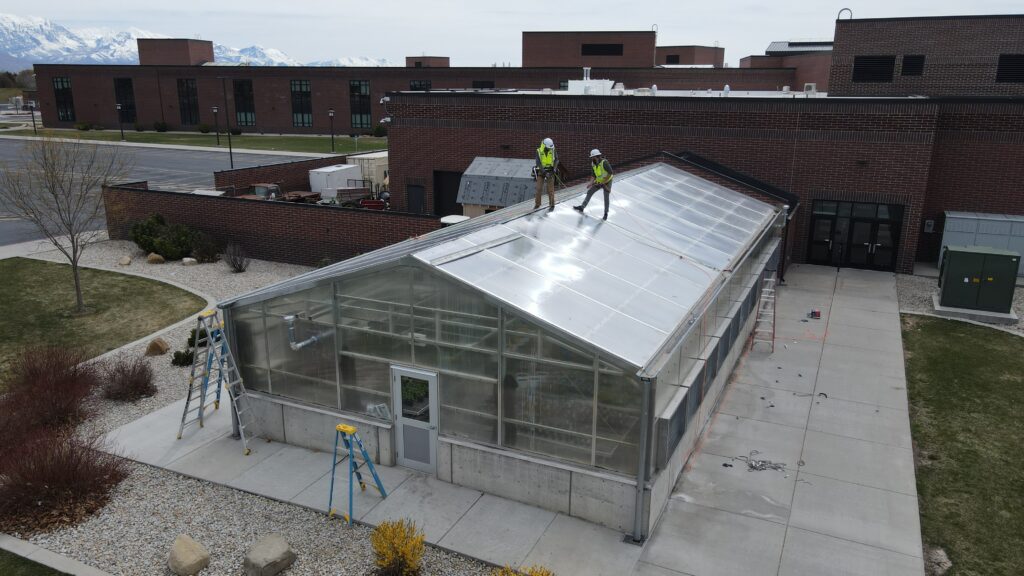
Most school greenhouses do not fail during construction. They fail afterward.
Maintenance success looks deceptively simple. Day‑to‑day operation is handled locally by staff who understand the system. High‑risk or highly technical work is handled by professionals. Maintenance schedules align with the school year, and there is a clear path for escalation when something goes wrong.
Maintenance failure, on the other hand, often stems from misplaced responsibility. Teachers are asked to manage systems they did not choose and were never trained to maintain. Facilities teams avoid greenhouse work because it falls outside their experience. Problems are addressed reactively rather than through routine inspection.
A clear division of roles protects everyone involved. Teachers should focus on daily operation with appropriate training. Districts and facilities teams should manage contractors, budgets, and oversight. Professional greenhouse contractors should handle high‑risk or high‑skill work where the time required to learn the system does not pay off.
Do not assign management responsibility to people who are unclear on the role or the outcome. Structure reduces burnout and prevents small issues from becoming major failures.
Phase Three: Greenhouse Programs
Monarch does not advise on greenhouse curriculum or program design. However, facility decisions play a quiet but decisive role in whether programs succeed.
One reality schools regularly encounter is that not every agriculture teacher is interested in running a greenhouse program. This is not a failure of professionalism or commitment — many teachers simply prefer other instructional areas such as mechanics, welding, or animal science. When a greenhouse program depends entirely on the enthusiasm of a single teacher, the program becomes fragile.
Successful greenhouse programs are designed so that interest, not obligation, drives participation. The facility and expectations are structured in a way that allows teachers to opt in meaningfully, rather than feeling trapped by a program they did not choose.
Programs that survive staff changes tend to share a few characteristics:
- The greenhouse is not owned by a single teacher’s personal interest
- Expectations for greenhouse involvement are clear and limited
- Program scope matches available interest and capacity
- The facility can operate at a basic level even when instructional focus shifts
Successful greenhouse programs spend very little time worrying about the facility itself. Systems are predictable and understandable. Layouts support program goals instead of working against them. Facility complexity matches staff capacity.
When the facility works quietly in the background, teaching can lead.
Teachers and Administrators: A Shared Challenge
Greenhouse programs rarely struggle because teachers do not care or administrators do not try. They struggle because greenhouse facilities expose unclear responsibility faster than many school systems are designed to handle.
Teachers operate closest to daily reality. Administrators are responsible for long‑term outcomes and risk. Both are constrained by the systems they work within. Clear expectations and defined ownership reduce frustration on both sides and create space for collaboration rather than conflict.
Conclusion: The Big Picture
A successful school greenhouse is not heroic or fragile. It is quiet, predictable, and well-defined.
This guide introduced the big picture of the greenhouse journey in schools — how construction, maintenance, and program use must align to produce reliable outcomes. More detailed guides can explore each phase in depth, but the principle remains the same.
When expectations are clear and responsibility is assigned, greenhouse facilities stop being a risk and start becoming long‑term assets.
When facilities work, growing and teaching can lead.
Learn more: